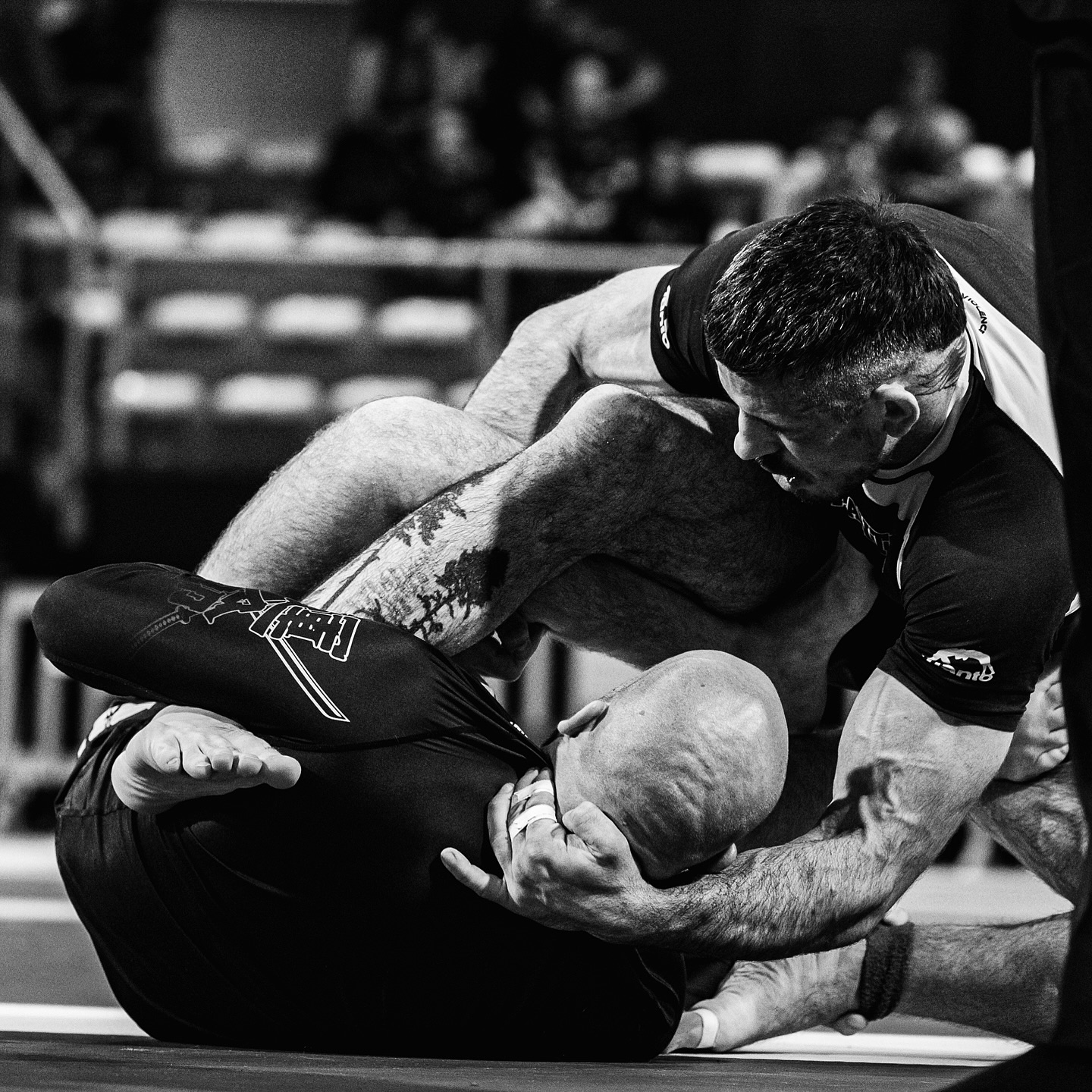
Attacking from bottom side control isn't the standard plan in BJJ. The standard plan is to escape, create space, and recover guard. Sometimes, though, the top player makes a mistake, drags his weight too far forward, and leaves an open lane for an unusual counter. One such option is called Bermuda — a combination of the triangle and the armbar from a very disadvantageous position. It can work, but only under certain conditions. For most people, the more important thing is to understand when it's a real opportunity and when it's better to go back to a normal escape.
- what the Bermuda technique means
- what situation it comes from
- what its principle is
- when it can work
- when it almost certainly fails
- the most common mistake people make with it
- why it isn't a substitute for a basic side control escape
What the technique is
Bermuda is an unusual counter from bottom side control — that is, from the situation where you're lying on the bottom, your opponent is controlling you from the side and has the positional advantage.
Under normal circumstances, in bottom side control you're mainly protecting the neck and arms, framing, moving the hips, and trying to get your knees back between you and your opponent. Bermuda runs against this normal logic in just one specific moment: when the top player overcommits to attacking your arm or reaches forward enough that he loses some of his control over your head, hips, or the space around your shoulders.
The principle
The principle isn't "catching something out of nothing." The principle is exploiting too much space that the opponent gives you himself.
- the top player drives in side control
- he starts hunting for your arm — for an Americana attack or similar isolation
- he shifts his weight too far forward or too high
- he loses some of his control over your torso and head
At that moment, you can throw a leg over the top part of his body and try to close a combination resembling a triangle with pressure on the arm. In practical terms: you use his bad angle and his extended arm against him.
The important thing is that this isn't brute force. It's working with timing, space, and angle.
When it works and when it fails
- the opponent shifts his weight too far forward
- he stops controlling your hips
- he focuses solely on your arm and stops watching the legs
- he creates unnecessary space between his torso and your body
- the opponent holds tight side control with good pressure
- you have a strong crossface and can't turn your head or torso
- the opponent controls your hips and won't release space
- you're lying flat, no frames, no angle
- you try to "force" the technique through strength or flexibility alone
In a situation where it fails, Bermuda usually isn't a smart counter. It's usually just a bad attempt at a save, after which mount, a back take, or even worse control often follows.
For a moderately advanced grappler, knowing about Bermuda as an option can be useful. For a beginner, the important thing is to know that the option exists, but not to treat it as the main plan.
The most common mistake
From bottom side control, the rule still stands: defense and framing first, the counter — if any — second.
How to use it in practice
Use it mainly as an observational filter during sparring. Next time you're under side control, don't just feel the pressure. Watch where the opponent is shifting his weight, whether he's hunting your arm, whether he's controlling the hips, and whether he's giving you space for the upper leg.
Even if you never finish a Bermuda, this trains you to read the opponent's mistakes. And that's a practical benefit on its own.
Conclusion
Bermuda is an interesting counter, but it doesn't belong among the techniques a beginner should build his bottom side control defense around. It's worth knowing, because it shows just how much space, angle, and the opponent's mistake decide the outcome in BJJ. But it shouldn't be overrated. If the conditions aren't there, going back to frames, hip movement, and recovering guard is still the better play.
BJJ glossary
Ashi garami, heel hook, knee reaping — every term in the article is laid out clearly in our glossary, including pronunciation and IBJJF rules.
Open the BJJ glossary →Follow Daniel on Instagram
500K+ followers, technique breakdowns, and clips from training. @ragnar_bjj — leg lock specialist and IBJJF European medalist.
Follow @ragnar_bjj →Train the system, not the tricks
Ragnar Academy — full-length instructionals: leg locks and no-gi the way Daniel teaches them at seminars. Patreon membership, opening autumn 2026.
Notify me when we open →