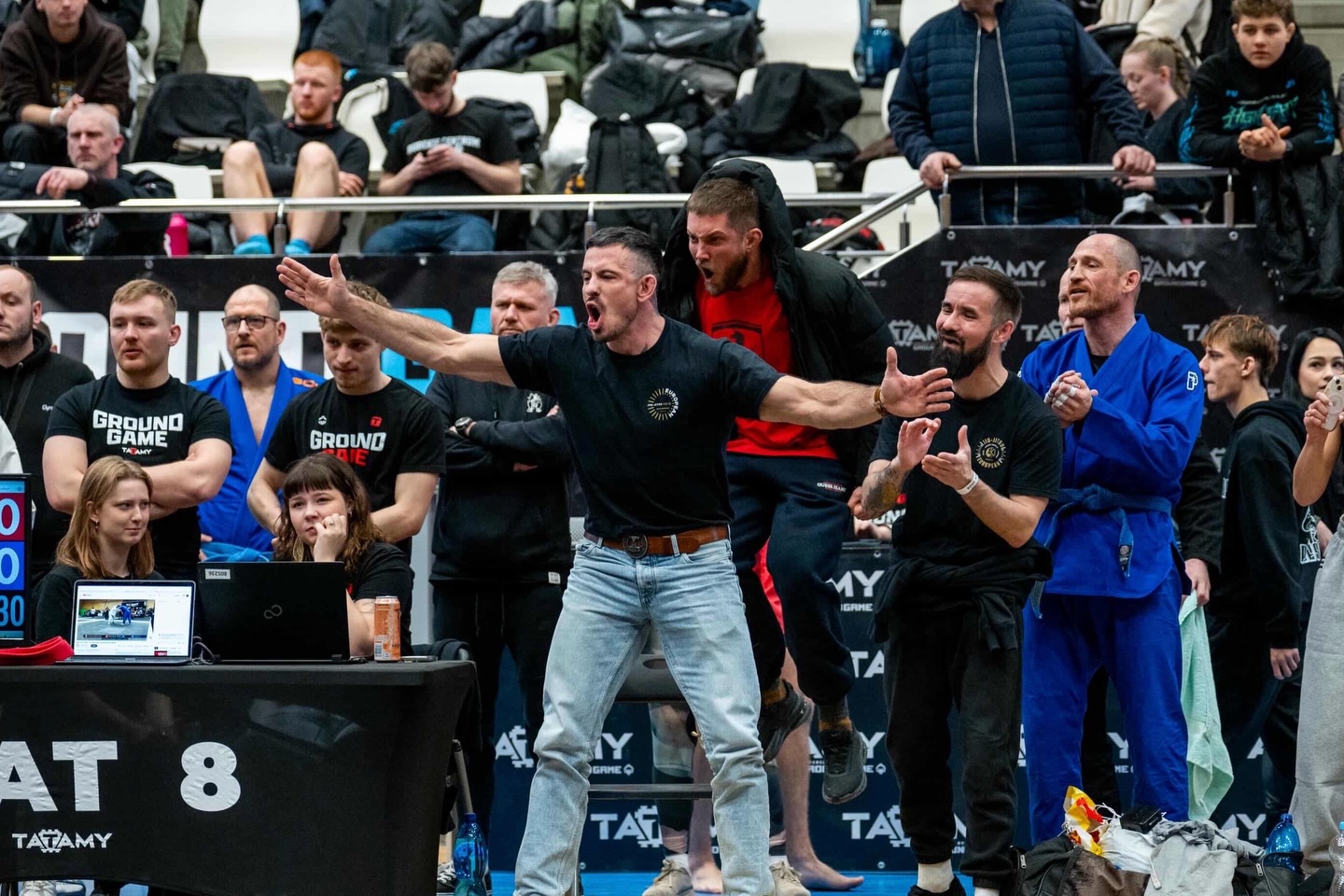
For most people, the first Brazilian Jiu-Jitsu training is a mix of adrenaline and confusion. New terms, unfamiliar positions, people who look like they know exactly what they're doing. This text is for anyone considering how to start — or someone walking onto the mat for the first time in the next few days who wants to know what they're getting into.
- complete beginners who haven't tried BJJ yet
- people after a trial class deciding whether to continue
- parents wanting to assess whether BJJ is a safe start for them or their child
- BJJ
- Brazilian Jiu-Jitsu — a martial art focused on ground fighting, joint locks, and chokes.
- Gi
- The traditional kimono with a belt, worn in gi classes. No-gi is the version without the kimono (rashguard + shorts).
- Roll / sparring
- Free sparring in training, where you practice techniques against your partner's resistance.
- Tap
- The 'I give up' signal — tapping with your hand or foot. Immediately ends the technique.
- Guard
- The basic defensive position where the fighter is on his back and controls the opponent with the legs.
- Submission
- A finishing technique — a joint lock or choke that forces the opponent to tap.
What BJJ is and why to start
Brazilian Jiu-Jitsu is a martial art that originated in Brazil at the turn of the 20th century from Japanese judo and ju-jutsu. The basic idea: a smaller and weaker person can defeat a larger and stronger one if they understand leverage, angles, and positional hierarchy. The fight is taken to the ground, where physical strength plays a smaller role than technique.
In practice, BJJ is a combination of sport, self-defense, and physical-mental training. On the mat, you solve problems in real time: your opponent moves, resists, comes up with answers. In an hour of rolling, you'll sweat more than in an hour of weightlifting, and at the same time it keeps your head in the present — you don't have time to think about work.
What you need before your first training
Gear
- Gi (kimono): Most academies lend a gi for the first 1–2 sessions. Call ahead. Buy your own gi once you know you're going to stick with BJJ — it costs €60–160.
- Rashguard + shorts: For no-gi classes. A rashguard is an elastic shirt that doesn't slip and protects the skin. Shorts without pockets or zippers (those would catch on your partner).
- Mouthguard: Recommended mainly for no-gi and sparring. Costs €10–35; protects your teeth and lips.
- Flip-flops / slippers: You walk on the mat barefoot, but off it (changing room, bathroom) your foot should never be bare.
Hygiene
Hygiene is BJJ's unwritten rule number one. You're skin-to-skin with your partner for an hour. Show up showered, in a clean gi or rashguard, with trimmed nails on your hands and feet. If you have any skin infection, a herpes outbreak, or nasty abrasions — stay home. Skin-borne infections (impetigo, ringworm) are a classic problem in BJJ, and decent athletes protect each other.
What to expect at your first training
The structure of a class is similar in most academies and lasts 60–90 minutes:
- Warm-up (10–15 min): Conditioning elements, BJJ-specific movements — shrimping, bridging, technical stand-up. If you're at zero fitness, it won't be pleasant, but you'll survive.
- Technique demonstration (15–25 min): The coach shows a specific movement or sequence. Usually 1–3 techniques from a single positional context.
- Drilling (15–20 min): You repeat the technique with a partner, without resistance. This is where the movement gets into the body.
- Sparring / roll (15–30 min): Free sparring against a partner. In many academies, beginners have optional sparring for the first few weeks — you don't have to try it on day one.
Don't expect to understand everything. In the first month, it's normal to feel completely lost. That's correct — the body is learning movements it has never done, and the head is finding its way around a system that takes a while to start making sense.
Etiquette — the unwritten rules
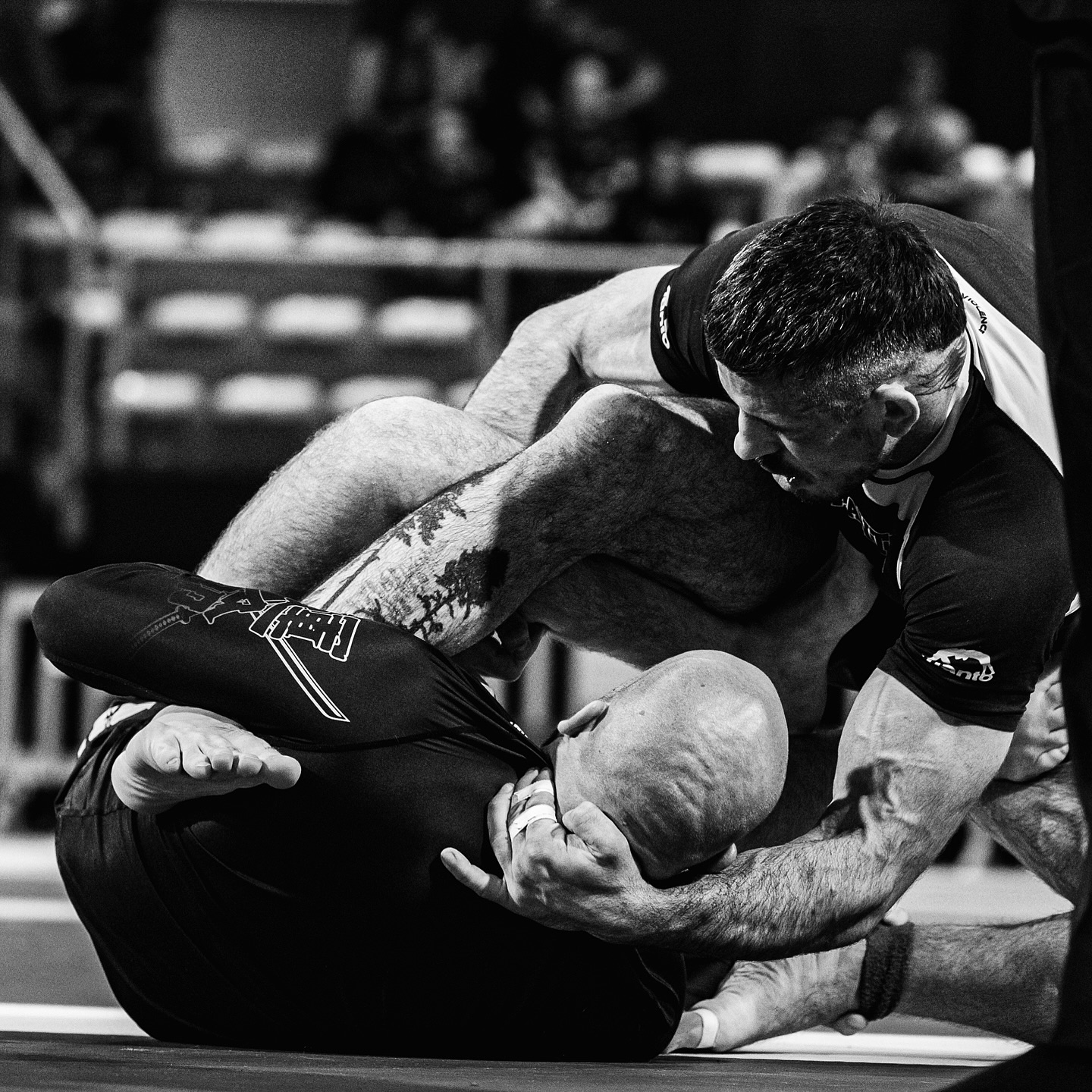
A BJJ academy has its own culture. Not knowing the rules isn't an excuse, but every solid academy will tell you them in the first few days. The basics:
- Greet the coach and your training partners. A handshake or fist bump at the start and end of a roll is the standard.
- On the mat only barefoot. No socks, no shoes. Take everything off before stepping on.
- Don't interrupt the coach's technique. If you want to fine-tune something, wait for the drill break.
- Tap early and often. The more of a beginner you are, the earlier you should tap. A tap isn't a loss — it's training.
- Roll appropriately. Against a weaker or smaller partner, you don't go 100%. BJJ is a long game; your partner is a colleague, not an opponent in the ring.
- Don't be a silent ninja. If something hurts or you have an old injury (knee, shoulder), tell your partner before the roll. You'll save both of you a problem.
Tapping — the heart of safety
Tapping is the most important thing you'll learn in BJJ — right at the start. When your partner sets up a lock or a choke, you tap their body or the mat 2–3 times with your hand, or you say "tap." Your partner immediately releases the technique. No heroics, no "I'll hold on a moment longer." Underestimating the tap is the main cause of injuries in BJJ.
The first 90 days — how not to get discouraged
Most people who quit BJJ give it up in the first three months. Not because of the conditioning — because the feeling of "I don't know anything" is frustrating. A few things that handle that feeling:
Train two or three times a week, no more
In the first 12 weeks, twice a week is the minimum and three times the optimum. Four or more sessions a week in the first months leads to injury, burnout, or both. The body needs to sleep and recover — that's where it remembers techniques.
Focus on survival, not on attack
Forget submissions. The first 90 days are about learning not to panic when you're under guard or in side control. If you learn to breathe in a bad position and systematically escape from it, you'll gain calm on the mat — the precondition for all further learning.
Don't compare yourself to others
The more advanced training partners were once where you are now. Comparing yourself to a blue or brown belt after a month of training is a path to a needless feeling of inferiority. The only meaningful comparison is to yourself from last week.
The most common beginner mistakes
- Attacking from a bad position. When you're pinned underneath, don't go for the choke — first escape to guard. The submission only comes from control.
- Holding your breath. In a hard position, people instinctively tense up and stop breathing. Breathing decides whether you'll last a minute or ten. Inhale through the nose, exhale through the mouth.
- Strength instead of technique. If you're stronger than your partner, strength works in the short term. In the long term, it teaches bad habits. Technique always wins out in the end — strength only takes you to an injured shoulder.
- Refusing to tap. Every refused tap is a credit toward an injury. BJJ is trained over years. It isn't worth a few days of glory and half a year of recovery.
- Focusing only on YouTube techniques. Video study makes sense as a supplement, but it doesn't replace having a coach correct you in real time. And pick techniques that match your level and what you're currently covering with your coach.
Safety — when to stop
Some situations require you to stop the roll immediately, not tap:
- Sharp, unexpected pain in a joint — even without a lock. It could be an old injury. Your partner has to know.
- Dizziness, nausea, pressure in the head. Dehydration and underestimated recovery are solved by a break, not another roll.
- Blood. Even a small cut on the head or face = stop. A clean mat is an obligation, not a preference.
- Loss of orientation. If you don't know where you are or what's happening, sit down and wait for the coach.
With submissions (especially with higher-risk techniques — chokes and leg locks), if you don't tap in time, real injury can happen. With advanced techniques like leg locks (e.g., the heel hook), a timely tap is essential, because the lock on the knee shows up late. Some techniques hurt even with light application — for instance, a calf slice can cause immediate sharp pain in the calf, which is a signal to tap, not to bravely hold on. Advanced positions like saddle (inside sankaku) and techniques like the knee bar are not trained in the first months — they have their own set of safety rules that come later.
Frequently asked questions
Conclusion
Starting BJJ isn't complicated — book a trial class and show up. The hard part is enduring the first 90 days, during which your brain learns a new language and your body learns new movements. If you keep humility, breathing, and a willingness to tap during this period, BJJ will reward you with one of the most meaningful sports you can do. Big city or small town — academies are everywhere now, and most have a free trial session.
BJJ glossary
Guard, mount, side control, shrimp, tapping — every term in the article is laid out clearly in our glossary, including pronunciation and IBJJF rules.
Open the BJJ glossary →Follow Daniel on Instagram
500K+ followers, technique breakdowns, and clips from training. @ragnar_bjj — leg lock specialist and IBJJF European medalist.
Follow @ragnar_bjj →Train the system, not the tricks
The Patreon membership opens in autumn 2026 at $9.90 a month. Join the newsletter — you'll hear the opening date first.
Notify me when we open →